
What a B2B Sales Process Audit Actually Looks Like in the Philippines
Philippine B2B companies often run on informal sales habits built over years. A structured sales process audit surfaces what's working, what's leaking revenue, and exactly where to fix it.
Share this article
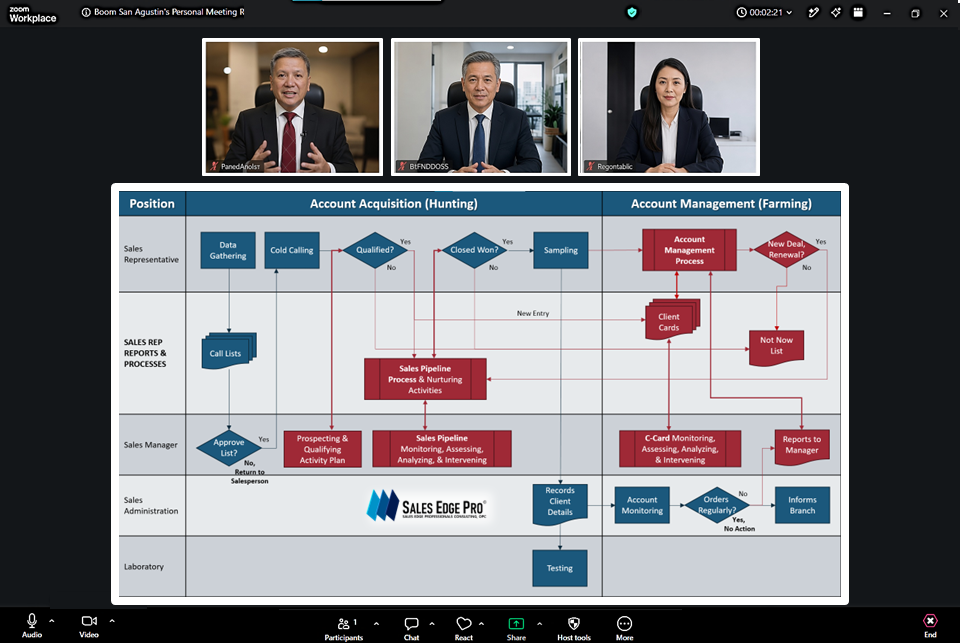
Why Philippine B2B Companies Need a Sales Process Audit
The Philippine B2B market has matured significantly over the past decade. Companies across Metro Manila, Cebu, and the regional growth corridors are competing for enterprise contracts, government projects, and multinational partnerships that would have been out of reach a generation ago.
But many of these companies are competing with sales habits built in a different era — relationship-driven, informal, and heavily dependent on a handful of senior people who carry the business on their backs.
That model works until it doesn't. When growth stalls, when key people leave, or when a well-funded competitor enters the market, the cracks in an informal sales process become very expensive very quickly.
A B2B sales process audit is how you find those cracks before they find you.
What a Sales Process Audit Is — and Isn't
A sales process audit is a structured diagnostic of how your sales organization actually operates — not how it's supposed to operate on paper.
It is not a performance review. It is not a training program. It is not a CRM implementation project. It is a fact-finding exercise that answers one question: where is revenue being lost, and why?
The output is a clear picture of your current state, a prioritized list of gaps, and a practical roadmap for closing them.
The Five Areas a Sales Process Audit Covers
1. Pipeline Structure and Stage Definition
Most Philippine B2B companies have a CRM with stages — but the stages reflect internal milestones, not buyer behavior. "Proposal Sent" is a seller action. It tells you nothing about where the buyer is in their decision process.
An audit examines whether your pipeline stages map to real buyer decision points, whether reps are advancing deals based on objective criteria or gut feel, and whether your pipeline data is reliable enough to forecast from.
In our experience, most companies find that 30–40% of their "active" pipeline is actually stalled or dead — it just hasn't been cleaned out.
2. Discovery and Qualification Discipline
The discovery call is the highest-leverage conversation in B2B sales. It's where you earn the right to propose, uncover the real business problem, and differentiate yourself from competitors who lead with a pitch deck.
An audit looks at whether your team has a shared discovery framework, whether they're qualifying on budget, authority, need, and timeline — or just on interest — and whether discovery conversations are producing the information needed to write a winning proposal.
In the Philippine context, this is often where the biggest gaps appear. Relationship culture can make it feel rude to ask hard qualification questions. The result is a pipeline full of deals that were never real.
3. Proposal and Presentation Quality
A proposal is a sales document, not a technical document. An audit reviews whether your proposals are written from the buyer's perspective — articulating their problem, your solution, and the business case for acting now — or whether they're product brochures dressed up with a price list.
We also look at how proposals are delivered. In the Philippines, many companies still email proposals without a presentation meeting. This is a significant missed opportunity to handle objections, reinforce value, and advance the deal.
4. Objection Handling and Negotiation
How does your team respond when a prospect says "your price is too high" or "we need to think about it"? An audit surfaces whether reps have a consistent, trained approach to common objections — or whether they're improvising every time.
We also look at discounting patterns. Uncontrolled discounting is one of the most common revenue leaks in Philippine B2B sales. When reps discount reflexively rather than strategically, margin erodes without a corresponding increase in win rate.
5. Post-Sale Process and Expansion Revenue
The sale doesn't end at the contract. An audit examines whether your team has a structured onboarding and success process, whether there's a systematic approach to account expansion, and whether customer relationships are being managed proactively or reactively.
In B2B, the second sale is almost always more profitable than the first. Companies that don't have a post-sale process are leaving significant revenue on the table.
What the Audit Process Looks Like
A Sales Edge Pro sales process audit typically runs over three to four weeks and involves:
Week 1 — Discovery: Interviews with sales leadership, frontline reps, and a sample of customers. Review of CRM data, pipeline reports, and recent proposals. Observation of sales calls and meetings where possible.
Week 2 — Analysis: Pattern identification across the data gathered. Benchmarking against best practices for B2B sales in the Philippine and Southeast Asian context.
Week 3 — Findings and Recommendations: A structured presentation of findings, prioritized by revenue impact. A practical roadmap with specific, actionable recommendations — not generic best practices.
Week 4 — Roadmap Alignment: Working sessions with leadership to align on priorities, assign ownership, and build the implementation plan.
What Companies Typically Find
Every audit is different, but certain patterns appear consistently in Philippine B2B companies:
- Pipeline inflation: Active pipelines that are 2–3x larger than they should be, filled with deals that have been stalled for months
- Qualification gaps: Deals advancing to proposal stage without confirmed budget, authority, or timeline
- Proposal quality issues: Proposals that describe the product rather than solve the buyer's problem
- Discounting without strategy: Reps giving discounts as a first response to price objections rather than a last resort
- No post-sale process: Customer relationships managed informally, with no systematic approach to expansion or referrals
The ROI of Getting This Right
A well-executed sales process audit typically identifies revenue opportunities worth 20–40% of current annual sales — through a combination of better win rates, shorter sales cycles, reduced discounting, and improved account expansion.
For a Philippine B2B company doing ₱50 million in annual revenue, that's ₱10–20 million in recoverable revenue sitting in process gaps.
The audit itself is an investment. The cost of not doing it is much higher.
Is Your Sales Process Ready for an Audit?
If any of these sound familiar, a sales process audit is worth serious consideration:
- Your pipeline looks healthy but quota attainment is consistently below target
- You're winning deals but margins are eroding
- Your best salespeople are carrying the team and you don't know why
- You've grown to a size where informal sales habits are starting to break down
- You're preparing for a significant growth push and want to make sure the foundation is solid
Sales Edge Pro has conducted sales process audits for B2B companies across the Philippines and Southeast Asia. Book a consultation to discuss what an audit would look like for your organization.
Found this useful?
Share it with your sales team or network.
Explore Topics
Written by
Sales Edge Pro
Content creator and writer sharing insights and stories.